
Turtles of the Cedarburg Bog
Gary S. Casper – Originally published in the Fall 2007 issue of the BogHaunter
Turtles are old – really old. Something readily recognizable as a turtle, Proganochelys, walked the Triassic swamps about 225 million years ago. It had all the key features of modern turtles, plus small teeth on its palate – a feature since lost. The basic turtle body plan has worked so well that it has changed little for well over 200 million years.
In North America, turtles survived the doomsday Chicxulub asteroid impact in Yucatan approximately 65 million years ago, which nearly sterilized large portions of North America. Turtles then proliferated during the Age of Mammals, when a menagerie of large and frightening beasts such as mastodons, saber-toothed tigers, giant sloths, and dire wolves ruled the land.
Much later, the Ice Ages forced turtles south of advancing glaciers, only to plod northward again as glaciers retreated. In Wisconsin, the Cedarburg Bog area was scoured by an ice sheet approximately 12,000 years ago, a mere blink of an eye in geologic time. Since then, a few species of turtles, those ancient survivors, have managed to re-establish themselves in the Bog.
At least three species are known to inhabit the Bog, painted turtle (Chrysemys picta), snapping turtle (Chelydra serpentina) and the state Threatened Blanding’s turtle (Emydoidea blandingil). Two others, the spiny softshell (Apalone spinifera) and the Stinkpot (Sternotherus odoratus), are known from the region but not from the Bog (yet).
All of the Bog’s species are diurnal, active during the day from late March through early November, and prefer warm water and soft muddy bottoms, occupying well vegetated lakes, ponds, marshes, sloughs, oxbows, sluggish streams, and bogs.
The most familiar is the painted turtle. Widespread and common throughout the eastern U.S, they mature at 3-5 years (males) to 6-10 years (females) of age and may live 30-40 years. Clutch sizes average about 10-15,-and nesting is in June.
Females are often found seeking nest sites in dry, sunny, exposed soils. Sometimes second clutches are laid in late July. Painted turtles are commonly observed basking on logs and shorelines, a behavior which elevates body temperatures for metabolic benefits (e.g. digestion), exerts some control over external parasites such as leeches, and kills algae on their shells.
In winter, painted turtles hibernate in deeper water areas, and winter kills are known when prolonged ice cover results in extended periods of low or no oxygen. Diet consists mostly of aquatic invertebrates, which explains why painted turtles are most abundant where fishes are absent.
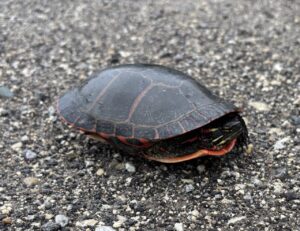
Painted Turtle
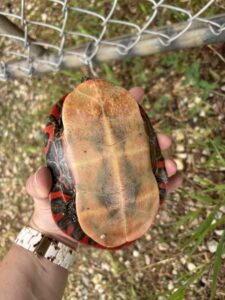
Painted Turtle
Also regularly sighted at the Bog is the snapping turtle. Snapping turtles are common residents of Mud Lake and other permanent and semi-permanent lakes and wetlands of the Bog. They mature at 4-5 years (males) to 12-15 years (females) of age and may live 40 years. Clutch sizes average about 20-40, and nesting is in June.
Snapping turtles bask only in early spring, which helps to shed the load of leeches accumulated over the winter. Like painted turtles, they hibernate in deeper waters and winter kills are known. They eat a variety of plant and animal matter and carrion. Contrary to popular belief, snapping turtles are generally insignificant as predators upon game fish and waterfowl, although they will take them occasionally. Up to a third of their diet can be plants.
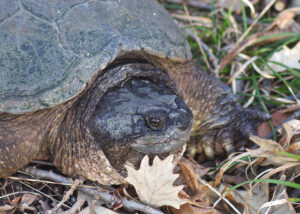
Snapping turtle
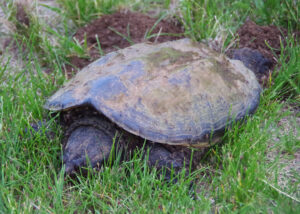
Snapping turtle
Less frequently seen is the Blanding’s turtle, named after a medical doctor in Philadelphia who first reported them to science more than a century ago. There have been a few sightings of both adults and juveniles at the Bog, where they appear to be a rare resident of Mud Lake and its environs. The first photographs of Blanding’s turtles from the Bog were obtained in 2006 – attesting to how rarely this Bog resident is observed.
Blanding’s turtles are especially appealing, with fine yellow speckling on black shells, big brown and yellow eyes, and a bright golden yellow chin and throat. They also have captivating personalities, being extremely docile and almost never biting. The growth rings on their shells can give an estimate of their age up to about 25 years or so (a new ring forms each winter).
Blanding’s turtle share certain life history features with humans – females reach reproductive maturity at about 15 years, and they live well over 70 years. They tend to favor ephemeral wetlands, especially in spring, and spend considerable time foraging on land in forests and fields in mid-summer. Clutch sizes average about 12, and like other species nesting females are often encountered along roads in June. They return to the same general nesting area year after year, and although they can nest annually in Wisconsin, they often skip a year. Basking is mostly in spring, especially just after spring emergence. Unlike other turtles, they sometimes hibernate in ephemeral wetlands by digging into mud or under hummocks or into vegetative bog mats, where prolonged oxygen deprivation can be severe. They seem especially tolerant of low oxygen and winter kills are rare, usually the result of freezing rather than oxygen deprivation.
Crayfish and other aquatic invertebrates are preferred prey items, and they also eat amphibian eggs and tadpoles (in season), plants, occasional minnows or carrion, and are suspected to consume fungi and earthworms during bouts of mid-summer terrestrial foraging. Blanding’s turtles are known for large activity ranges. Individuals I have radio tracked typically have a home range of about one square mile, including multiple habitats such as ephemeral wetlands and marshes for spring and summer foraging, grasslands and woodlands for mid-summer foraging, fields and roadsides for nesting, and deep lakes or ponds for winter denning.
A remarkable thing about turtles is their increasing fecundity with age – the older a female turtle gets, the more and better babies she has. Imagine grandma having sextuplets in her 60s while mom is only having twins in her 30s! This has conservation implications; because with most reproduction coming from old adults, and with juvenile mortality very high, there is essentially no harvest-able surplus of adults.
Unfortunately, adult mortality has greatly increased from harvest, poaching, and highway traffic; and mortality in all ages has increased from super-abundant urban predators (skunk, raccoon, fox, coyote, etc.) that predate on eggs in nests. These problems raise serious questions over the long-term viability of many turtle populations.
Some studies have shown that turtle populations near highways are skewed toward males – because the females are often killed while nesting. Better urban planning to reduce the impacts of road building and resultant habitat fragmentation would help turtles. Highway ecopassages, tunnels that allow turtles and other wildlife to pass safely underneath highways, are being tried in many areas.
We know little about the specific turtle community in the Bog, its ecology and conservation. How many turtles are there, what are their survival rates, reproductive challenges, and conservation issues? Road mortality, nest predation, and climate change are likely to be having negative influences on our turtles – but we have no specific data.
