
John O’Donnell, former FOCB Director
With their long serpentine neck and pure white plumage, swans easily capture your attention whether in flight or on water. Three of the world’s six species of swans are found in North America and Wisconsin. Trumpeter Swan and Tundra Swan are native species, and Mute Swan is introduced and considered invasive; all three have been found in the Bog’s Mud Lake.
All swans mate for life, often forming pair bonds as early as 20 months old which is well before they reach sexual maturity between three and six years. Most species perform a courtship ritual in which the female and male come closely together and bow their heads forming an elegant heart shape with a twist of their necks and bills. Swans are also quite vocal in their courtship displays which include synchronized swimming and head bobbing.
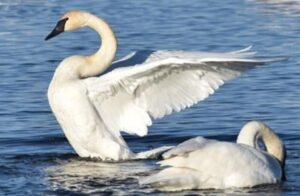
Trumpeter Swan pair, photo by John O’Donnell
The Trumpeter Swan (Cygnus buccinator) is migratory, nesting in Wisconsin, Minnesota, northwestern Canada, and Alaska. In the late 1880s, Trumpeters were completely extirpated from Minnesota and Wisconsin due to excessive unregulated hunting. They were reintroduced to Minnesota in 1986 and Wisconsin in 1989. The reintroductions were so successful that the Trumpeter Swan was removed from the Wisconsin Endangered Species List in 2009. Trumpeters are now nesting in most of Wisconsin and are doing especially well in the Horicon Marsh National Wildlife Refuge, and in 2023 two Trumpeters successfully fledged at least four cygnets in the nearby Cedarburg Environmental Study Area marsh. The Wisconsin population is estimated at over 7000 birds.
The Trumpeter Swan is the largest waterfowl species native to North America – at least four feet tall, with a wingspan over seven feet, and weighing 21 – 30 lbs. but large males may exceed 35 lbs. A Trumpeter can live for 20 to 30 years. Swans usually don’t nest until they are between three and six years old; however, they pair up around two years of age and typically stay together for life. Preferred nesting sites are large, somewhat isolated, shallow wetlands with a rich variety of aquatic plants to choose from, e.g., Sago pondweed and water milfoil along with emergent plants like arrowhead, burr-reed, bulrush, sedges, and other pond weeds. Nesting territories range from six to 150 acres in size. If a pair spends at least two summers at the same potential nest site, they invariably form a strong attachment to that site and come back the third or fourth summer to breed.
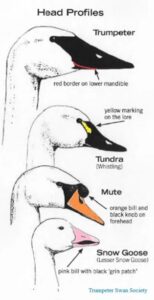
Swan head diagram
The Tundra Swan (Cygnus columbianus) is the only other native swan in North America . Every Spring and Fall these swans pass through Wisconsin on their way to and from their arctic breeding grounds in Canada and Alaska. Along the way, they stay at “stop over” sites to rest and fuel up. Mud Lake and Long Lake are two regular “stop over” sites where many hundreds of these swans sometimes hang out for days or even over a week. The Tundra Swan has a 6 ½ foot wingspan, weighs 13 – 20 pounds and stands at 47 to 58 inches. As is the case with other North American swans, juvenile plumage is grey and does not turn to white until the swan is close to one year old. Their feeding habits are essentially the same as those of the Trumpeter Swan. The North American Tundra Swan population is estimated to be 170,000.
From a distance, it can be difficult to distinguish between a Trumpeter Swan and a Tundra Swan. Tundra Swans are high arctic breeders migrating through Wisconsin twice a year flying high in a large group “V”. Trumpeters are usually found in pairs or small family groups. Trumpeter Swans almost always have black bills which extend to their eyes so that the eye seems to be an extension of the bill. The eyes of the Tundra Swan are distinctively separate from the bill. If a Trumpeter or two is mixed in with a foraging Tundra flock, the size difference between the two species is obvious.
Mute Swans (Cygnus olor) were introduced by European immigrants beginning in the 1880s and are considered invasive. The aggressive behavior of Mute Swans has been proven to have an adverse effect on the nesting and fledging success of native waterfowl. Efforts to reduce the number of Mute Swans are proving to be successful, and Mute Swan is now considered to be a rare bird in most parts of Wisconsin.
Mute Swan is relatively easy to tell from a Trumpeter or Tundra Swan because in contrast to the black bills of Tundra Swans and Trumpeters, the bill of a Mute Swan is bright orange with black edging and a black knob bulge at the base of the bill.
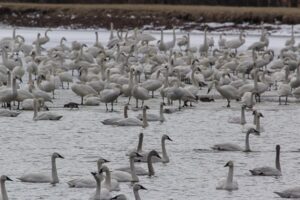
Tundra Swans in Mud Lake, photo by John O’Donnell
Mud Lake 2024 Swan Observations: Mud Lake is an integral part of the Cedarburg Bog Important Bird Area. At 235 acres, it is the largest and least developed lake in Ozaukee County. Both Mud Lake and nearby Long Lake are pretty well insulated from the sights and sounds of human activities. Both lakes are shallow water replete with the aquatic vegetation preferred by all three species. The limited human access to Mud and Long Lakes and the DNR prohibition of motors in the lakes make for a secluded semi-wilderness area suitable for migrant resting as well as potential nesting.
All three swan species spent days and, in some cases, continuous weeks and months exploring Mud Lake in 2024. A Mute Swan, a new bird listing on the Cedarburg Bog bird list, traversed Mud Lake for nearly five continuous weeks. The big news, however, relates to the pair of Trumpeters who spent the entire 2024 summer cruising about Mud Lake. Should these two return in 2025, they will likely have the territorial attachment needed for nesting. Since Trumpeters usually spend two summer seasons on a potential breeding site before actually nesting, we can hope that they return in 2025 and that we can celebrate their nesting in 2026.
