
Spring & Summer Birding in the Bog
Alex Mann
As summer comes to an end, it’s a good time to reflect on some of the great birds the Cedarburg Bog supported so far this year.
A Common Raven wandered the Bog area from mid-February to the end of April. This bird was typically observed flying just above the tree tops and croaking – probably looking for a mate. This will be a bird to watch for in the future as this species expands its breeding range south into more heavily human-altered landscapes.
The Friends of the Cedarburg Bog hosted six birding events this spring and summer. Event attendees found over 90 species during those trips! Spring highlights were singing Hooded Warblers, Black-billed Cuckoos feasting on tent caterpillars around the Field Station, a Least Bittern chuckling near the boardwalk bridge, many singing Scarlet Tanagers and Acadian Flycatchers, a Ruby-throated Hummingbird building a nest one spiderweb at a time, and multiple Brown Creeper nests.

Female Ruby-throated Hummingbird feeding nestlings in the bog. Photo by Alex Mann
The Field Station’s upland woods had two pairs of Brown Creepers nesting along a trail in May. Brown Creepers nest in this part of Wisconsin in very small numbers and seem to benefit from dead Ash trees. Their nests are typically under loose bark and are incredibly difficult to find. We were thrilled to discover and share these with some of our bird walk patrons.
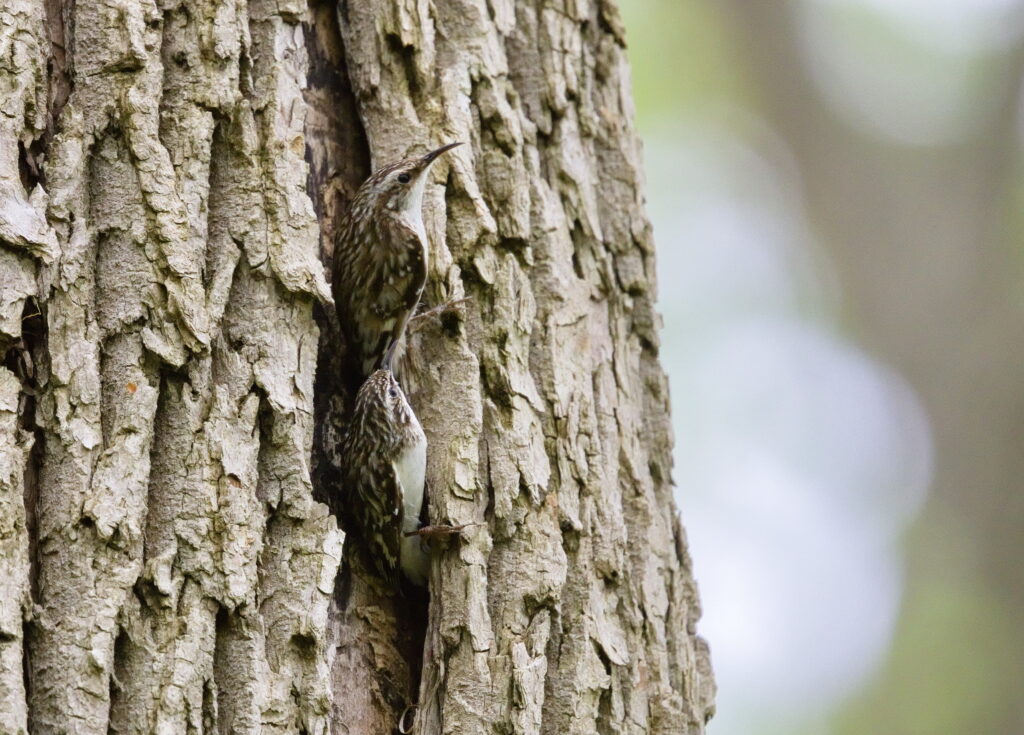
Pair of Brown Creepers leaving their nest under the bark of a dead Ash tree near the Field Station. Photo by Alex Mann.
At the very end of May, Mud Lake was visited by a pair of Yellow-headed Blackbirds – possibly a new bird for the bog!
As summer arrived and spring migrants moved on, a few species typically found further north stuck around in the upland woods. A pair of Chestnut-sided Warblers were observed feeding a Brown-headed Cowbird fledgling in June. A handful of Winter Wren fledglings were spotted closely following a singing adult.
It was a good summer for Acadian Flycatchers which are on the northern edge of their breeding range in the bog. Many Acadian Flycatchers were heard throughout the Field Station’s upland woods, as well as the forest at Watts Lake and further north up Blue Goose Rd.
Walk attendees who observed the Ruby-throated Hummingbird nests in the upland woods and bog boardwalk will be happy to know that each nest had 2 nestlings that presumably fledged.
Watts Lake and Horn Lake on the north end of the bog hosted Least Bittern, Acadian Flycatcher, Brown Creeper, Blue-winged Warbler, Northern Waterthrush, Black-and-White Warbler, and many more bird species.
Mud Lake had its usual nesting Wood Ducks, Pied-billed Grebe, Virginia Rail, Least Bittern, Yellow-throated Vireo, and Alder Flycatcher. An unexpected Ring-necked Duck likely spent the summer on Mud Lake. Tufted Titmouse was a new confirmed breeder for the bog. Titmice in this area typically don’t stray far from the Milwaukee River so finding them near Mud Lake was a pleasant surprise! Another unusual find here was a singing Canada Warbler in late July. This warbler species is a historic breeder here and doesn’t typically migrate through until August.
Special thanks to our 2026 spring/summer birding leaders: John O’Donnell, Alex Mann, Rachel Holzman, Steve Holzman, and Kira Dayton.
