
Sedges are an important part of our flora. How are they different than grasses? What are some of our most common sedges?
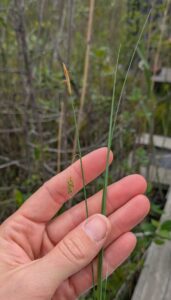
Sedges are commonly seen as grasses by the general passerby. Although they can look similar, there are many differences. One of the biggest differences is that sedges are tristichous. This means that their leaf arrangement is 3-ranked. Each blade is 120° from the next if you look at it from an aerial perspective. This differs from grasses that have 2-ranked leaf arrangement. On grasses, the leaves branch on opposite sides of the stem, 180° spacing. If you were to look at a cross section of the culm of a sedge, it would appear to be triangular in shape due to the 3-ranked leaf arrangement. The stems of grasses will be round and hollow. Sedges are more closely related to rushes than they are to grasses or graminoids. An easy way to help you distinguish what type of monocot you are looking at is the following pneumonic phrase, “Sedges have edges, rushes are round, and grasses are hollow all the way to the ground”.

Sedges have edges
You can find sedges across the globe. They are a very diverse genus and found in a variety of habitats. They dominate open wetlands and often that grass you are looking at on the forest floor is actually a sedge. The family Cyperaceae is commonly referred to as the sedges, however, this family also includes rushes. The largest sedge genus, Carex, the ‘True Sedges’ alone makes up about 7 percent of the flora of the upper Midwest according to Andrew Hipp, author of Field Guide to Wisconsin Sedges. Carex is then sorted into sections where species are grouped by similar characteristics. There are almost 200 species of sedges that can be found in Wisconsin.
Learning how to identify sedges is like learning a whole new language. The terminology can be daunting at first but after some exposure and repetition, you too can be speaking their language. What one would consider the stem of a sedge is actually called the culm. The inflorescence is classified as a spike. Each spike is made up of spikelets or flowers. A spike can be pistillate meaning it contains only female flowers. Or it can be staminate, only containing male flowers. Some spikes contain both male and female flowers. The perigynium is the capsule that covers the female flower parts with the stigmas protruding beyond to collect pollen grains. The perigynium is an important characteristic used to identify sedge species. It can vary greatly in size and color from species to species. There are many other ways to help you get to know sedges more intimately. Most species need to be in flower or fruiting stage to be able to confidently confirm their identity to species. Some require the assistance of a hand lens or microscope.
Carex limosa flower spike

Carex stricta flower
In wetlands, Carex stricta, Tussocks sedge, is one of the most dominant species in the Great Lakes Region. This species dominates sedge meadows and can be easily seen while walking on the boardwalk into the Cedarburg Bog. The dark scales adjacent to the perigynium create a beautiful pattern in the spikes. Another distinguishing feature can be found at the base of the culm. Here the sheath displays a pattern called ladder fibrillose. In wetlands where the water level fluctuates on a regular basis, this species creates evenly spaced tussocks. These tussocks are ecologically significant and can be home to a diversity of flora and fauna.

Tussock sedge ladder fibrillose
Out in the string bog, where the nutrient level drops due to the anaerobic environment of the soils, we see Carex limosa, Mud Sedge, become a dominant species. This species is commonly found in the flarks of the string bog. Flarks are open areas where herbaceous species, such as sedges, dominate the vegetation. The flarks are bordered by strings that are dominated by woody species such as white cedar and tamaracks. C. limosa has a unique reproductive strategy. In the fall the vegetative culms elongate to create stolons. These stolons lay along the surface and at each node, new fertile culms are produced to essentially create new plants. This is a vegetative way that some sedges use to reproduce.

Carex limosa in flark
Carex intumescense, Greater Bladder Sedge, is one of the easiest sedges to identify when it is flowering or in the fruiting stage. It is in the Carex section Lupulinae, Bladder Sedges, where the perigynium consistently measures more than 10 mm in length. This is drastically larger than one of the more delicate sedge species, Carex eburnea, whose perigynium ranges from 1.6-2.3mm in length. C. intumenscense is commonly found along margins of mesic deciduous wetlands where the soils can be periodically saturated. You can see this species as you come onto the islands found within the Cedarburg Bog.

Carex intumescense
Moving further out of the wetter areas of the Bog and up onto the top of the islands, you continue to be surrounded by a diversity of sedges. Carex pennsylvanica, Pennsylvania Sedge, is a common species of dry woodlands. With the high amount of deer pressure on our woodlands due to fragmentation, sedges such as C. pennsylvanica, are becoming more dominant. This is because deer favor consuming forbs instead of sedges or grasses. Most sedges bloom in spring but this species in particular is an early bloomer. It can be seen in flower as early as April 1st.

Carex pennsylvanica in bloom
These are just a few species of sedges that have a home in the Cedarburg Bog and probably your local wetland or woodland. On your next hike through your favorite natural area, I hope you will slow down to enjoy the wonderful world of sedges, as well as other flora. And remember, “Sedges have edges, rushes are round, and grasses are hollow all the way to the ground”.
