
A rare Cerulean Warbler was observed in the Field Station woods for the first time in over a decade. Why have Cerulean Warblers become so rare?
On June 6, 2025 and again on June 7, a male Cerulean Warbler provided occasional glimpses as it sang and moved its way through the upper forest canopy of the UWM Field Station upland woods. Singing nearly nonstop and moving in a wide circle, the warbler was behaving as though it might have been scouting for a breeding territory! Unfortunately, however, this rare bird was not present on June 10th nor the following three days thereafter. This sighting was significant in that it is the first confirmation of a Cerulean Warbler in the woods in over ten years. Prior sightings were very brief one day encounters likely with migrant birds such as recorded in 1995 (William Mueller), 1996, 2011, and 2015. Based on records kept by UWM ornithologist Dr. Charles Weise 50 plus years ago, Cerulean Warblers were not just migrants passing through, but one or two pairs on average were annual nesters in the Field Station woods from the early 1970s to the early 1980s.
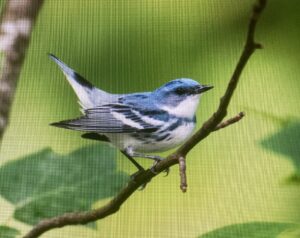
Male Cerulean Warbler
Cerulean Warblers have sadly declined by about 70 percent over the past 50 years. Once an abundant species wherever there were large tracts of mature upland forests in eastern North America and southern Wisconsin, this small iconic songbird is now considered to be one of the most threatened species in the continental United States. The largest threat to Cerulean Warblers has been the fragmentation and loss of large patches of mixed old growth oak-hickory, maple, and basswood forests. Whenever a forest becomes fragmented, the Brown-headed Cowbird will move in and parasitize the nests of smaller birds. Cowbirds thrive in fragmented forests. Cowbird parasitism has been a major factor in the decline of Cerulean Warblers and other neotropical species as well. Adding further to the decline of the Cerulean Warbler is deforestation and fragmentation of the mountain forests along their 2500-mile route through central America into the mountain forests of northwestern South America where the Cerulean Warbler overwinters. Climate change is probably also contributing to the decline of Cerulean Warblers due to weather-related changes affecting the springtime emergence of insect prey. Approximately 50% of the Cerulean Warbler diet consists of forest caterpillars which do not appear until the trees have leafed out.
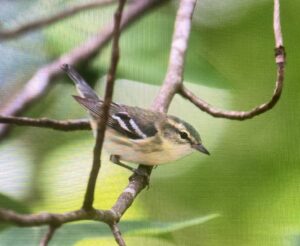
Female Cerulean Warbler
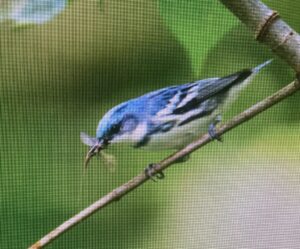
Male Cerulean Warbler
Cerulean Warblers typically forage in the upper canopy of the forest and so are more often heard than seen. They are a challenge to find and to identify if not singing. Males have a sky-blue head and upperparts, with blackish wings and tail, two white wing bars on each wing, and a blackish chest band. Females have a blue-green head and upperparts, blackish wings and tail, two white wing bars, and pale yellow underparts in the chin and breast. Cerulean Warblers in Wisconsin are most concentrated in both the North and the South segments of the Kettle Moraine State Forest, the Baraboo Hills, and the Lower Wisconsin and Mississippi River bluffside forests. They are actually abundant in much of Wyalusing State Park near Prairie du Chien! Cerulean Warblers have also been recorded along the River Trail at the nearby Riveredge Nature Center once or twice every five years or so. In 2019, they were listed as a “possible breeder” in the first Wisconsin Breeding Bird Atlas.
The Cerulean Warbler is a beautiful bird well worth pursuing. If ever you are near to their prime breeding habitat, learn the song and then pursue the songster! If you are in the right place at the right time, this is a thrill that you will likely remember the rest of your life!
