
FOCB stewardship volunteers have been busy with two projects in the past couple months.
Garlic mustard in the Field Station Beech-Maple Forest State Natural Area
Including the 18-acre “Wright Tract” owned by The Nature Conservancy, the Field Station’s Beech-Maple Forest (State Natural Area #61) is 80 acres of one of the finest examples of old-growth upland forest remaining in southeastern Wisconsin. The sand and gravel glacial deposits and extreme kettle-hole glacial topography make the woods an atypically dry variety of sugar maple and American beech dominated forest.
Adjacent to the Field Station’s woods to the west is another 40 acres of privately-owned old-growth forest that is rich with ephemeral ponds that are highly valuable as amphibian breeding habitat. Together, these 120 acres of old-growth are a natural area of great regional and statewide importance.
Garlic mustard (Alliaria petiolata) was first identified in Wisconsin in 1938. It did not become widely established and recognized as a severe ecological problem across the state until the late 1980s and 1990s when after decades of slow, localized growth, the plant underwent an aggressive population explosion. By the late 1980s, it went from a minor curiosity to an aggressive, widespread invader across Wisconsin’s woodlands. Garlic mustard can spread aggressively because it can grow in deep shade, lacks natural predators in the Midwest, and produces thousands of seeds per plant (Wisconsin DNR).
Since the Station’s forest is used by the public for education and research it was inevitable that garlic mustard would be introduced by mud on visitors’ boots if not by wildlife movement from adjacent properties. The first garlic mustard plant was found in the Field Station woods around 2004. By 2007 Field Station staff and the Friends of Cedarburg Bog had the foresight to recognize that the only way to prevent an eventual severe infestation and spread of garlic mustard would be to conduct annual searches and remove the isolated first-colonizers that would come into the forest. With the land-owner’s permission, the block of privately-owned forest to the west was also included in the annual searches. Garlic mustard does not respect property boundaries, and the ecological importance of those woods was recognized.
A route was developed to thoroughly search the woods in a systematic way. Friends’ volunteers continue to help the Field Station with the annual searches which have just been completed for 2026. We find and pull small patches of garlic mustard, and we celebrate when we find and pull individual, isolated, plants because they represent a next-year’s-patch prevented. Thanks to these efforts the Field Station Beech-Maple Forest State Natural Area is still mostly garlic mustard free.
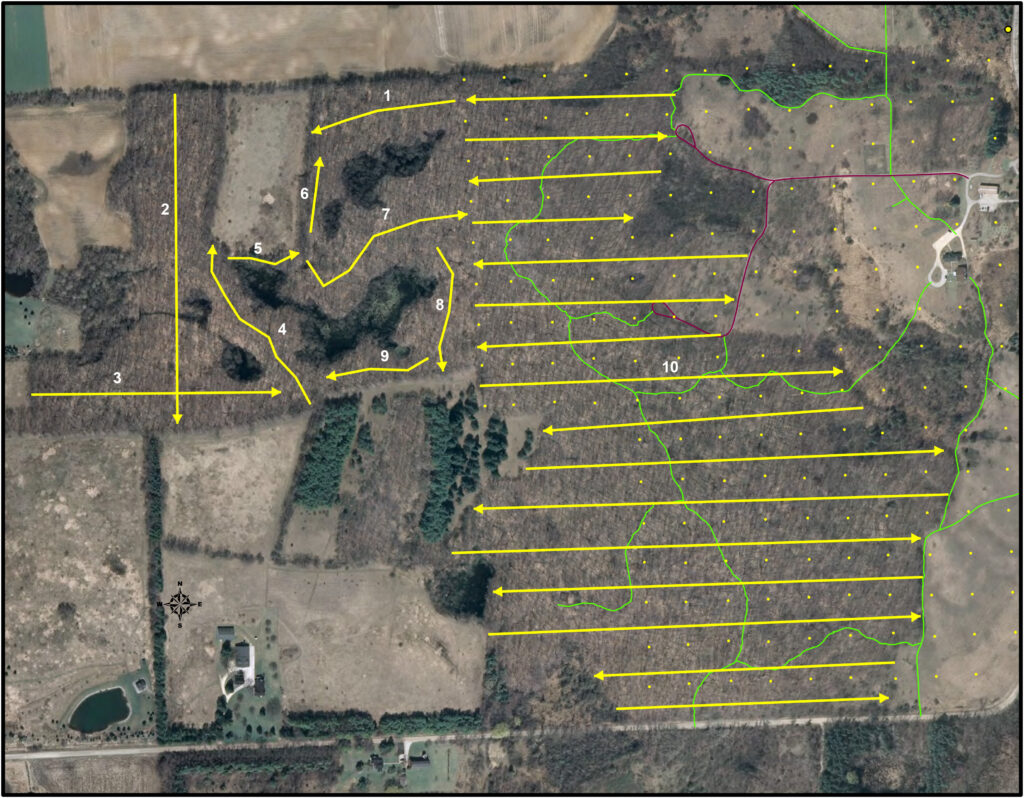
Route used to systematically search the Field Station’s forest and the private forest to the west. The dots represent the permanent grid marker location in the university-owned part of the forest.
Raising Purple Loosestrife Control Beetles for Release on the Mud Lake Population
For a third year, FOCB volunteers led by Christine Bohn from our Stewardship Committee are raising Galerucella or “Cella” beetles to continue biocontrol of the Mud Lake population of invasive purple loosestrife. Purple loosestrife appears to have been introduced to Mud Lake by duck hunters who used it to construct their blind. It is now well-established chemical control is not feasible because of the difficulty of access in the floating cattail mats.
Fortunately, a biological control beetle has been found and developed for use in North America. In Eurasia, where the plant and beetle are native, the beetle is a specialist on purple loosestrife. Its entire life cycle depends on the purple loosestrife plant, making it a perfect candidate for biological control. Its feeding does not typically kill purple loosestrife, but it stresses the plant keeping it smaller and can often completely prevent seed production and spread.
On May 4, before purple loosestrife had begun much growth, the FOCB crew dug plants from a local population, put them in buckets, and moved them to the cattle tanks at the Station where the beetles are being grown. They let the plants grow without beetles until June 10 when they put about 10 beetles on each plant and netted them.
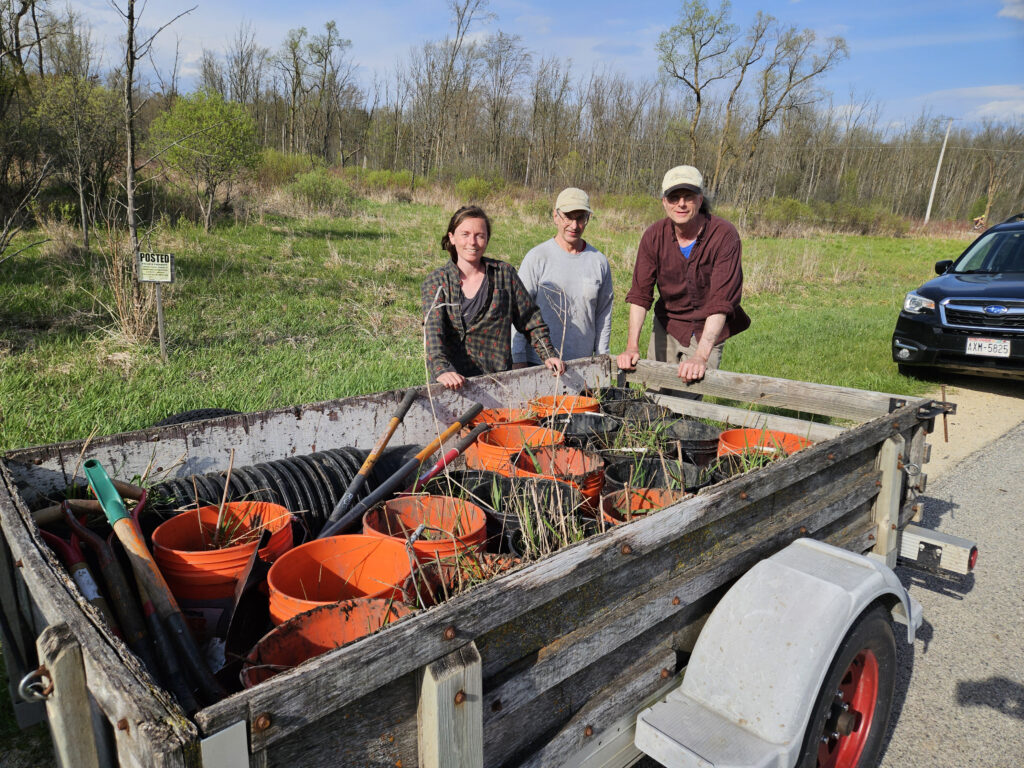
Christine, Tom, and Marty with dug purple loosestrife plants ready to haul to the Field Station’s cattle tanks.
The beetles will lay their eggs and multiply. They will be ready to be released when there’s not much foliage left on the plants and there should be a large number of beetles. At that point in late July or early August, we will load the plants into canoes and take them out to Mud Lake for release. The project’s volunteers are planning an inspection of the purple loosestrife on Mud Lake later in the season to see what density of beetles are present from previous releases and the level of damage to the loosestrife population.
Alex Mann, Tom Thornton, Marty Honel, Jaymi Holland, and Jim Reinartz are helping Christine with the project. Thanks to all our FOCB volunteers.
Collecting about 10 beetles to place on each netted purple loosestrife plant.
Netting the plants to contain the beetles which will multiply on the plants.
