
Sandhill Cranes – Sound of the Wild
By Kate Redmond, Originally printed in the newsletter of the Lake Michigan Bird Observatory
If you wanted to see a Sandhill Crane in southeastern Wisconsin fifty years ago, you had to travel to the Cedarburg Bog, where a pair reliably nested at the south end of that 2,300 acre wetland. One pair, not two – the cranes didn’t like company.
Sandhill Cranes have been around for 2.5 million years, and we almost lost them. Plentiful when settlers started farming Wisconsin in the mid-1800’s, their numbers fell as their habitat was destroyed, and they were shot as crop pests and for food (one long-ago hunter called them the “ribeye of the sky”). Greater Sandhill Cranes are the subspecies that calls Wisconsin home, and by the 1930’s, there were only about 1,000 of them east of the Mississippi. Wisconsin hosted about 50 of them.
The great conservationist Aldo Leopold believed they would become extinct and lamented their passing in an essay in Sand County Almanac called “Marshland Elegy.” He wrote, “Someday, perhaps in the very process of our benefactions, perhaps in the fullness of geological time, the last crane will trumpet his farewell and spiral skyward from the great marsh. High out of the clouds will fall the sound of hunting horns, the baying of the phantom pack, the tinkle of little bells, and then a silence never to be broken, unless perchance in some far pasture of the Milky Way.”
With the protections for birds that were brought by the Migratory Bird Treaty Act of 1918, and for wetlands that resulted from the Migratory Bird Conservation Act in 1929, cranes started to rebound. Still, in his 1991 book Wisconsin Birdlife, Sam Robbins listed the Sandhill Crane as an “uncommon migrant and uncommon summer resident.” Their reproductive biology explains their slow recovery – cranes produce only one or two chicks (called colts) per season, and typically, only one survives. They may not breed until they are four or more years old.
Greater Sandhill Cranes (Antigone canadensis tabida) are hard to miss. Four feet tall with a six foot wingspan, adults have long bills, a red forehead, white cheeks, and gray plumage that may look rust-stained due to iron in the soil that sticks to the birds’ beaks and is transferred as they preen. About the same size as Great Blue Herons, they fly with necks and legs extended (herons usually tuck their necks in). Their wings are narrower than a heron’s, and the upstrokes of their shallow wingbeats seem more empathic than the down strokes. Males and females look alike, and young birds are browner. They have a vocabulary of bugles, honks, hisses, and snores, some of which can be heard for miles. They soar admirably, and it’s not uncommon to hear their calls coming down from high up in the sky.
Another subspecies, the Lesser Sandhill Crane (Antigone canadensis canadensis), numbers more than a half-million birds and lives in central North America. These birds breed in the Arctic and stage spectacular migrations through the Great Plains that are recorded by cameras at the Audubon Society’s Rowe Sanctuary. Fifteen states allow crane hunting, almost all of them involving the Lesser Sandhill population.
Cranes are omnivores, feeding in wetlands and uplands on seeds, berries, and tubers, plus invertebrates and vertebrates (including rodents, snakes, frogs, and even small birds). They may also eat sprouting agricultural crops in spring and glean waste corn after the fall harvest. Because cranes nest on the ground, foxes, raccoons and coyotes prey on the young birds, and so do crows, raptors, and gulls; their attacks are rebuffed by hissing and kicking adults. I used to live a mile away from the Cedarburg Bog, and no matter what time I went outside at night, they were always very vocally awake, protecting their young from nocturnal prowlers.
Nests are broad piles of vegetation that is collected by both males and females, but the female does the majority of the incubating. Colts are able to leave the nest and follow their parents after about eight hours. Both parents feed the young at first, and within eight to ten weeks, the young birds are as big as their parents and are able to fly.
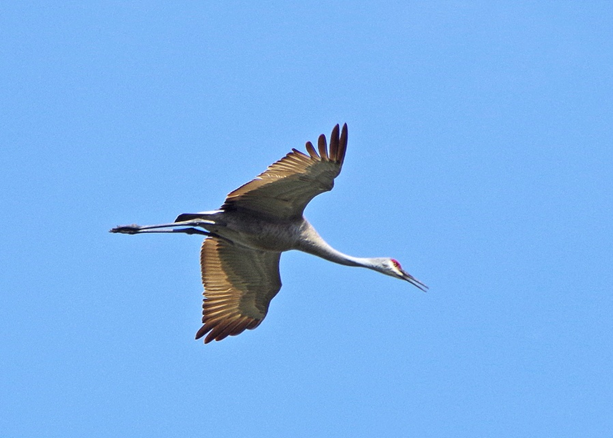
Sandhill crane in flight
Juveniles migrate south with their parents, but the next spring they join a roving “bachelor flock” until they’re old enough to pair off. Cranes mate for life and stay together during the winter, but they will find a new mate if one dies.
Fun Fact – Cranes court with energetic bobbing, leaping dances that include a call-and-response by the male and female, and the best dancer wins.
Wisconsin now has 30,000 to 40,000 Greater Sandhill Cranes, a little less than half of the entire eastern population, and volunteers turn out every April for the Annual Midwest Crane Count to help census them. As their numbers have increased, so has their tolerance for other pairs of cranes breeding nearby. Leopold would be happy to hear that. He said “When we hear his call we hear no mere bird. We hear the trumpet in the orchestra of evolution. He is the symbol of our untamable past, of that incredible sweep of millennia which underlies and conditions the daily affairs of birds and men.”
For more information about Greater Sandhill Cranes, see:
Scroll down to view a map of the cranes’ possible response to climate change.
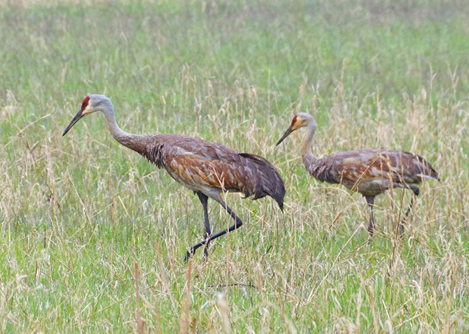
Sandhill cranes
